
Vest-Agder Rosemaling
Vest-Agder rosemaling belongs to the decorative painting traditions of southern Norway. Its story can be followed through the objects that furnished a home: painted chests, boxes, beds, and drinking bowls. These were usable possessions whose decoration could also display skill, personality, and a sense of occasion.
A dated starting point
One particularly helpful landmark is a ferry hut painted in 1780 by Tore Asbjørnsen Risøyne, then about eighteen years old. Vest-Agder-museet identifies him as the region’s earliest known rosemaler and describes his influence on later painters.
“Earliest known” is an important distinction. A surviving dated work documents a painter’s activity; it does not tell us the exact day a whole regional tradition began.
More than flowers
A bowl dated 1788 and probably painted by Risøyne illustrates a wedding procession. Riders, a bride wearing a crown, animals, and written verses turn its curved surface into a story. Such an object broadens our view of rosemaling beyond floral patterns alone.
When looking at decorative painting on a round vessel, imagine turning it in your hands. Different scenes or ornaments become visible in sequence. On a flat clock face, by contrast, the whole composition is presented at once. That difference gives modern designers a different problem to solve.
Reading a floral arrangement
For the floral clocks in this selection, begin at the center and compare the two sides. Notice the spacing of the flowers, the direction of the leaves, and how light shapes stand against a darker ground. These observations help you enjoy a design without treating every color choice as a historical rule.
The clocks below are contemporary interpretations associated with Vest-Agder rosemaling. Their connection is decorative inspiration, not a claim that they reproduce the museum objects described here.
Explore related clocks
-
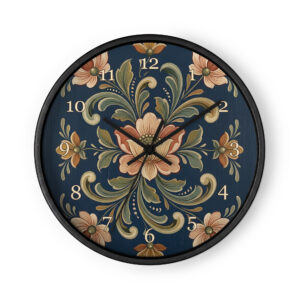
Norwegian Rosemaling – Vest-Agder Folk Art, Dark Blue
$54.99 Select options This product has multiple variants. The options may be chosen on the product page -
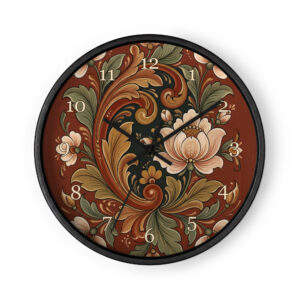
Vest-Agder Rosemaling – Cream Flowers and Gold Scrolls
$54.99 Select options This product has multiple variants. The options may be chosen on the product page