
Ryfylke Rosemaling
Ryfylke rosemaling places flowers at the center of the composition. Roses, tulip-like forms, and open blossoms can gather around an upright axis, giving the pattern a clear structure. The name connects the painting with Ryfylke in southwestern Norway.
From traveling painters to local practice
Ryfylkemuseet traces modest early examples to around 1700, followed by a wider presence in ordinary homes during the second half of the eighteenth century. The tradition became stronger in the nineteenth century, and the museum describes a developed Ryfylke style by about 1820.
Painters arriving from Hallingdal, Telemark, and Setesdal helped bring decorative ideas westward. Local painters become identifiable in the nineteenth-century record. The growth also belonged to a period of economic opportunity, including farming, timber, and herring fishing.
Recognizing the arrangement
Flowers tend to take a prominent role, with leaves and scrolling lines supporting them. A vertical center or a cross-like organization can hold the design together. Small differences between the two sides keep symmetry from becoming mechanical.
Try following the pattern from its largest flower outward. Where do the smaller blossoms repeat? Which leaves link one part to the next? This way of looking reveals how a dense arrangement can still feel orderly.
Ryfylke and Rogaland
In contemporary rosemaling terminology, Ryfylke is often associated with “Old Rogaland.” It should be distinguished from the later American Rogaland interpretation. The names are related, but they should not be treated as interchangeable descriptions of every design.
Our Ryfylke-themed clock is a contemporary floral interpretation. The historical background offers a way to appreciate its arrangement, while the clock itself belongs to a modern home and a modern design process.
Explore related clocks
-
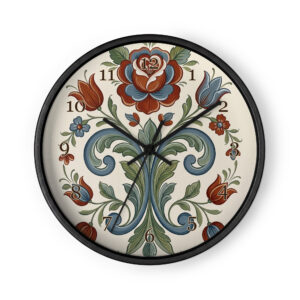
Ryfylke Rosemaling – Cream Red and Blue Flowers
$54.99 Select options This product has multiple variants. The options may be chosen on the product page