
Trøndelag Rosemaling
Trøndelag rosemaling is best approached as a family of local expressions. The region’s painters worked across different communities, and their surviving decorations do not fit into one fixed palette or a single arrangement of flowers.
Two different historical settings
In southern Trøndelag, Erik Erikson Horne, who lived approximately from 1730 to 1798, combined painting with woodcarving. His documented church work includes Lønset in 1774–1776 and Øksendal in 1783. The broader group of blue decorative paintings associated with his name involves questions of attribution, so it is more careful to speak of a circle or tradition than to assign every related object to his hand.
Farther north, Ole Olsen Heimvågsåsen worked in Snåsa around 1800. Vesterheim’s teaching material notes that the 1801 census described him as a carpenter and painter. Cupboards with contrasting panels and trunks with colored bands form part of the work associated with him.
Flowers, outlines, and movement
Heimvågsåsen’s decorative vocabulary included tulips, roses, smaller flowers, and fruit. Dark foliage could connect brighter forms, creating movement around an urn or along a rising stem. This is one painter’s distinctive approach, rather than a rule for the whole region.
When you look at a Trøndelag-inspired design, trace the connecting lines as carefully as the flowers. A thin outline, a repeated curve, or a small patch of dark color may do much of the work of holding the composition together.
A regional name with room for variety
The name Trøndelag helps locate the tradition, while individual painters and objects explain its differences. Our related clock is a contemporary design associated with that regional inspiration. It is not presented as a reproduction of a particular historical cupboard or church painting.
Explore related clocks
-
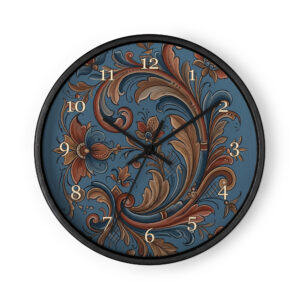
Trondelag Rosemaling – Blue and Red Scrollwork
$54.99 Select options This product has multiple variants. The options may be chosen on the product page