Norwegian Chip Carving
Chip carving, called karveskurd in Norwegian, creates decoration by cutting into a wooden surface. Small geometric cuts can combine into rosettes, stars, borders, and repeating fields. The effect depends as much on shadow as on the outline of the pattern.
A geometry of repeated cuts
A compass and ruler can help organize the design before carving begins. Circles establish repeated petals, while straight lines divide a border into measured sections. Each removed piece leaves a small recess that catches light differently from the surrounding wood.
This makes chip carving different from simply drawing a pattern on top of a surface. The ornament is part of the material itself. It is also a craft found across Europe, rather than an exclusively Norwegian invention.
Objects with a purpose
Norwegian examples include useful household objects as well as keepsakes. Book-shaped wooden cases from the eighteenth and nineteenth centuries could protect hymnbooks or Bibles; smaller examples also served other storage purposes. Carved names and dates could make an otherwise practical container personal.
A mangle board dated 1750 in Vesterheim’s collection combines a stylized horse handle with three decorated roundels. It shows how figurative carving and geometric surface ornament can work together on the same object.
How to read the pattern
Choose one small triangle or petal and see how often it repeats. Then step back and notice the larger shape made by those repetitions. A complex-looking design can be built from a surprisingly small set of forms.
The clocks below use imagery inspired by chip carving and geometric wood decoration. Their appearance refers to carved ornament; the clock-face designs themselves are printed images, not individually chip-carved wooden surfaces.
Explore related clocks
-
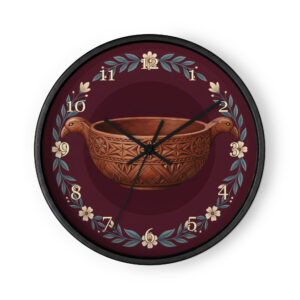
Norwegian Folk Art – Bird Head Kjenge and Chip Carving
$54.99 Select options This product has multiple variants. The options may be chosen on the product page -
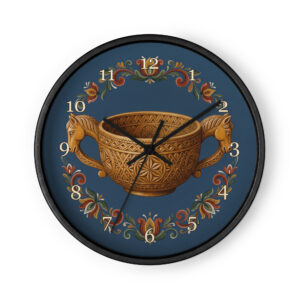
Norwegian Folk Art – Horse Head Kjenge and Chip Carving
$54.99 Select options This product has multiple variants. The options may be chosen on the product page -
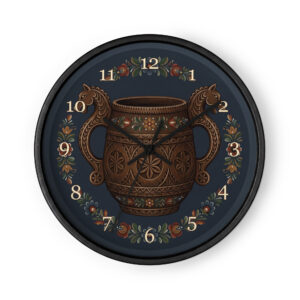
Norwegian Folk Art – Ornate Kjenge and Geometric Carving
$54.99 Select options This product has multiple variants. The options may be chosen on the product page