Heart Motifs in Norwegian Folk Art
A heart can make an elaborate ornament feel immediately familiar. In Norwegian folk-art-inspired design, its clear outline works well beside leaves, scrolls, and carved-looking details. The surrounding decoration can be intricate while the central shape remains easy to recognize.
A symbol with more than one setting
The heart belongs to a much wider visual history than Norwegian folk art alone. In European Christian imagery it can represent love, faith, or courage, while in personal gifts it can suggest affection and attachment. Its meaning depends on the object and its context.
For that reason, a heart on an old wooden object should not automatically be called a wedding symbol, a religious emblem, or an ancient protective sign. Evidence about the particular piece matters.
A documented example from Hallingdal
Vesterheim preserves a pair of wooden wedding spoons made by Odd Haugen of Hol in Hallingdal and dated 1900–1930. A carved chain joins the spoons, and heart-shaped openings decorate their handles.
Here, the museum’s identification gives the hearts a clear setting: an object associated with marriage. The openings are also part of the craft. Instead of adding a separate heart to the surface, the maker created the shape by removing wood.
Shape and surrounding ornament
Look at the point of a heart and the two curves at its top. Those simple features establish a center around which other forms can turn. Leaves may frame it, scrolls may echo its curves, or a darker background may make it stand forward.
Our heart-themed clocks pair that recognizable outline with acanthus-inspired decoration. The wood-like and golden effects belong to the printed design. They bring the visual warmth of the motif to a contemporary clock without claiming to be carved historical objects.
Explore related clocks
-
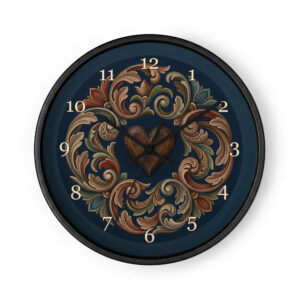
Norwegian Folk Art – Dark Wood Heart and Acanthus Scrolls
$54.99 Select options This product has multiple variants. The options may be chosen on the product page -
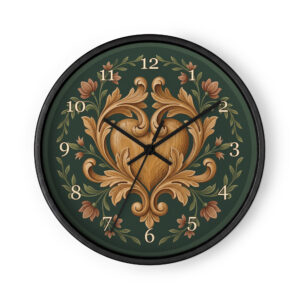
Norwegian Folk Art – Golden Heart and Acanthus Leaves
$54.99 Select options This product has multiple variants. The options may be chosen on the product page -
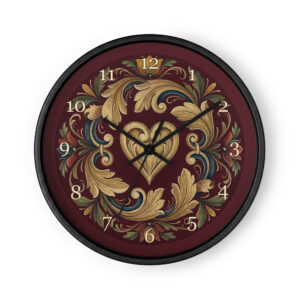
Norwegian Folk Art – Golden Heart and Flowing Acanthus
$54.99 Select options This product has multiple variants. The options may be chosen on the product page -
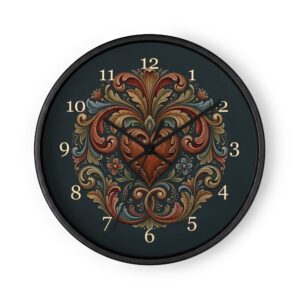
Norwegian Folk Art – Wooden Heart and Acanthus Crown
$54.99 Select options This product has multiple variants. The options may be chosen on the product page -
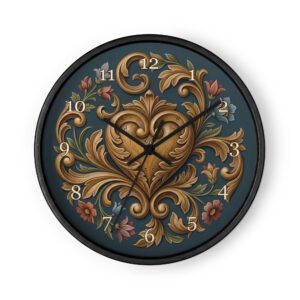
Norwegian Folk Art – Wooden Heart and Acanthus Decor
$54.99 Select options This product has multiple variants. The options may be chosen on the product page