Horses in Norwegian Folk Art
The horse appears in Norwegian folk art as a whole animal, a rider’s companion, or a simplified head built into a useful object. Its curved neck and recognizable profile give makers a strong shape to work with, even when the details are highly stylized.
An animal close to daily life
Horses belonged to the practical world of travel and work. Sverresborg preserves a travelers’ stable from Røros, probably built in the early eighteenth century, with room for fifteen small horses. Such a building helps place the animal within everyday history rather than treating it only as an ornament.
Folk art could give the horse additional meanings, but those meanings varied. Norsk Vegmuseum discusses the horse-shaped mangle board within the tradition of betrothal gifts and hopes for a good family life. That context does not mean every carved horse served the same purpose.
When a handle becomes a horse
A mangle board dated 1750 in Vesterheim’s collection has a highly stylized horse handle above geometric decoration. The animal gives a practical grip a distinct personality. Horse-headed drinking vessels offer another way for an animal form to become part of an object’s structure.
In these examples, usefulness and decoration are closely connected. The raised head or arched neck is not simply an illustration placed on a surface.
From carved form to a clock image
A contemporary design can explore the same recognizable outline in a different medium. A full horse suggests a scene; a horse and rider suggest action; paired horse heads can create balance around a vessel.
The clocks below bring together those horse-related motifs. Their connection is the subject itself, rather than a claim that every design belongs to one regional painting style or carries one fixed historical meaning.
Explore related clocks
-
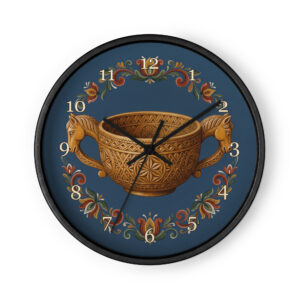
Norwegian Folk Art – Horse Head Kjenge and Chip Carving
$54.99 Select options This product has multiple variants. The options may be chosen on the product page -
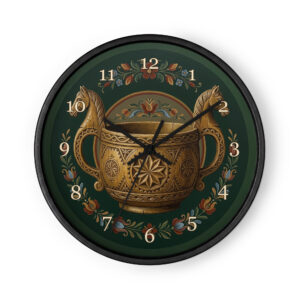
Norwegian Folk Art – Horse Head Kjenge and Star Motifs
$54.99 Select options This product has multiple variants. The options may be chosen on the product page -
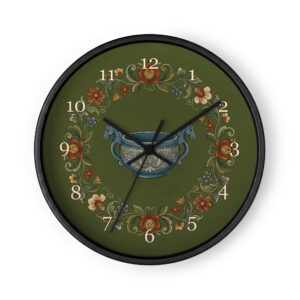
Norwegian Rosemaling – Blue Horse Head Kjenge
$54.99 Select options This product has multiple variants. The options may be chosen on the product page -
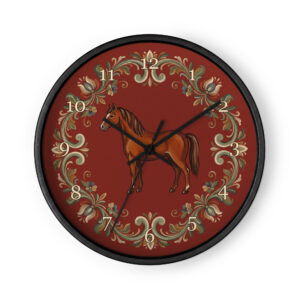
Norwegian Rosemaling – Chestnut Horse
$54.99 Select options This product has multiple variants. The options may be chosen on the product page -
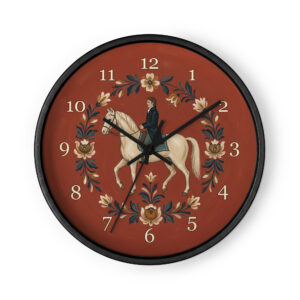
Norwegian Rosemaling – Horse and Rider
$54.99 Select options This product has multiple variants. The options may be chosen on the product page -
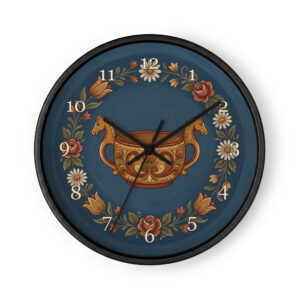
Norwegian Rosemaling – Horse Head Kjenge
$54.99 Select options This product has multiple variants. The options may be chosen on the product page