
The Norwegian Christmas Goat
The Christmas goat connects several different kinds of seasonal imagery. In Norway, julebukk can refer to people going from house to house in disguise, while a small straw goat is a familiar decorative form. The visiting custom and the ornament should be distinguished, even though both share the goat’s name.
Going julebukk
Today the custom often involves children visiting homes during the days after Christmas, singing and receiving sweets or cakes. Older accounts describe different costumes and sometimes more unruly performances. Practices varied by place, rather than following one national script.
Several explanations have been proposed for the custom’s origins. Comparisons with older goat symbolism are interesting, but they do not establish a continuous, unchanged tradition from the Viking Age to a modern Christmas decoration.
The goat as a straw ornament
A straw goat can be recognized through a few strong features: four legs, an upright neck, and curved horns. Bundled material and visible ties give the figure its structure. In an illustration, those details also help make the crafting process readable.
A family craft scene
The clock below shows a contemporary nisse family making straw crafts. Its connection to the Christmas goat is the recognizable ornament and the shared activity. Look at how the small figure becomes the center of attention, with the family gathered around an object they are creating together.
Explore related clocks
-
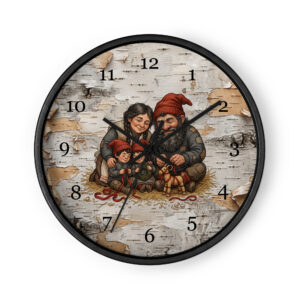
Norwegian Santa Family – Straw Goat Crafts
$54.99 Select options This product has multiple variants. The options may be chosen on the product page