
Glass Fishing Floats
Glass fishing floats began as working equipment. Their purpose was to help support a net in the water, while weights below kept it extended. Today, their rounded shapes and enclosing nets also make them recognizable reminders of coastal life.
Norwegian glassmaking in the 1840s
In 1843, the Bergen merchant Christopher Faye proposed making fishing floats from glass. Early examples were produced at Hadeland Glassverk in 1843–1844, and their shapes differed from the familiar round ball. Åsnes Glassverk produced round floats in 1847.
The material offered an advantage over wooden floats that absorbed water, although glass could break. An enclosing net helped protect the float and provided a way to attach it to fishing gear. Plastic alternatives arrived in the 1950s and gradually displaced glass in everyday use.
A practical object with visual character
The sealed hollow interior provides buoyancy. The surrounding cord creates another pattern across the smooth surface: knots and crossing lines divide a sphere into smaller fields. In an illustration, highlights can suggest glass while the darker cord makes its curve easier to read.
Coastal imagery at home
Our glass-float clocks explore the object on its own and within a composition with driftwood. Their appeal comes partly from that meeting of surfaces: smooth glass, rough cord, and weathered-looking wood. The designs invite a closer look at equipment whose original beauty grew from a useful job at sea.
Explore related clocks
-
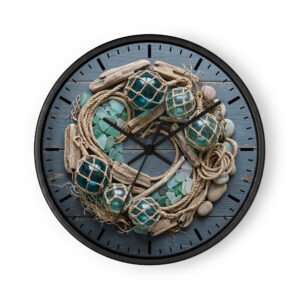
Norwegian Coastal – Glass Fishing Floats and Driftwood Wreath
$54.99 Select options This product has multiple variants. The options may be chosen on the product page -
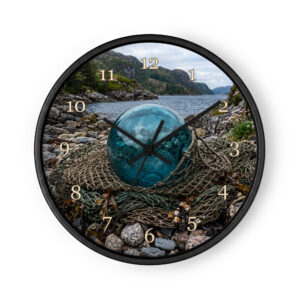
Norwegian Glass Fishing Float
$54.99 Select options This product has multiple variants. The options may be chosen on the product page -
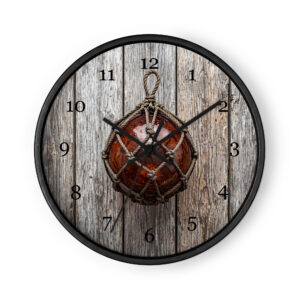
Norwegian Glass Float
$54.99 Select options This product has multiple variants. The options may be chosen on the product page