
The Crow’s Nest: A Lookout at Sea
A crow’s nest gave a lookout a raised position above a ship’s deck. Its name suggests a small enclosed perch, but the work involved careful observation of the surrounding sea. The height and shelter were useful parts of its design.
A place to watch
Traditional examples resembled a barrel mounted in the rigging. The sides offered some protection from wind while allowing the lookout to observe in different directions. On sailing ships the position was associated with the forward mast; later vessels also carried lookout stations in their forward rigging.
Whalers and sealers used elevated lookouts to spot animals. Lookouts also watched for other ships, icebergs, ice edges, and openings in the ice. Information first traveled by shouted messages and later through communication equipment.
Observation as part of teamwork
Seeing something was only the first step. A useful observation also had to reach the people directing the vessel. The crow’s nest therefore belongs to the history of communication and shared responsibility aboard ship.
Today, bridge watchkeeping and electronic equipment perform much of the work once associated with the masthead position, although enclosed elevated lookout stations still exist on some vessels.
A viewpoint in maritime imagery
The related clock makes the lookout its subject. An elevated figure can suggest both distance and concentration: someone is searching beyond the immediate deck. Consider how the mast, the surrounding space, and the figure’s posture establish that sense of watching a wider sea.
Explore related clocks
-
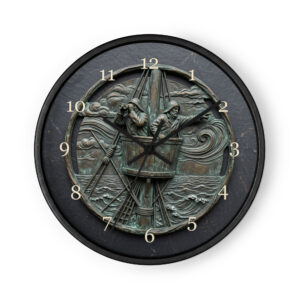
Norwegian Crow’s Nest Lookout
$54.99 Select options This product has multiple variants. The options may be chosen on the product page