
Crabs Along the Norwegian Coast
A crab’s broad body and strong claws give it an unmistakable presence in coastal imagery. Beneath that familiar outline lies a varied group of animals, with different species occupying different parts of the shore and seabed.
A Norwegian example: the brown crab
The brown crab, Cancer pagurus, occurs in substantial numbers along much of Norway’s coast, from Skagerrak to Troms, with occasional records farther north. It is one example of the crabs found in Norwegian waters, rather than an identification of every crab shown in a decorative image.
Rocky ground and kelp forests provide important settings for this species. Its diet includes many animals, particularly shellfish and marine worms. The crab is therefore part of an active food web, interacting with the smaller creatures around it.
Growing through a changing shell
A crab’s hard outer covering protects it, but growth requires molting. Early life also differs from the adult form: brown-crab larvae spend time in the water before settling to the bottom. The compact animal seen on the seabed represents one stage of a longer development.
Reading a crab design
Claws, legs, and the edge of the carapace create a distinctive arrangement of shapes. A designer can emphasize that structure through contrast and spacing. Our red-crab clock uses the broader crab theme; its color alone should not be used to assign a scientific species. Look instead at how the central body and spreading limbs fill the circular field.
Explore related clocks
-
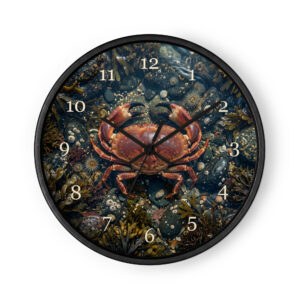
Norwegian Red Crab
$54.99 Select options This product has multiple variants. The options may be chosen on the product page