
Jellyfish in Norwegian Waters
A jellyfish can make water seem visible. Its soft outline, trailing structures, and translucent appearance suggest movement through a space that otherwise has few fixed boundaries. The subject is familiar along Norway’s coast, although the everyday name covers more variety than it first suggests.
A shape within a life cycle
For many familiar jellyfish, the free-swimming, bell-shaped animal is the medusa stage. The life cycle can also include a small attached polyp. The floating form is therefore not necessarily the animal’s appearance throughout its entire life.
Moon jellyfish and lion’s mane jellyfish are well-known examples in Norwegian waters. They belong to the cnidarians. Comb jellies, despite a similarly gelatinous appearance, belong to a separate animal group. Not every transparent drifting creature should be treated as the same kind of jellyfish.
Details that change the impression
The edge of the bell can look delicate while the trailing forms create longer lines below it. In an image, those differences provide a contrast between a compact center and a loose, flowing outline.
A stylized illustration may emphasize that visual rhythm without showing enough detail to identify a species. That leaves room to appreciate the form while keeping scientific identification open.
Jellyfish in coastal design
The related clock uses a jellyfish as its central subject. Look at how the surrounding space supports the impression of drifting, and how light and darker areas separate the soft body from the background. The result brings an underwater theme to an everyday object.
Explore related clocks
-
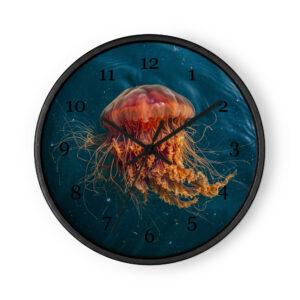
Norwegian Jellyfish
$54.99 Select options This product has multiple variants. The options may be chosen on the product page