
Scallops Along the Norwegian Coast
The scallop shell is recognizable through its fan-like outline and radiating ribs. In coastal design, those repeated lines can suggest an entire shoreline through a single object. The living animal, however, belongs to the seabed rather than the beachcomber’s collection.
A Norwegian example
The great scallop, Pecten maximus, occurs in the northeastern Atlantic from the Iberian Peninsula north to Vestfjorden. In Norway, substantial concentrations have been recorded in Trøndelag and Nordland, especially at depths of five to thirty meters. The species also occurs at much greater depths.
It commonly rests in a depression in the sediment with its flatter valve facing upward. Its food consists of small suspended material, including plankton and other microorganisms. The shell surrounds an animal adapted to feeding within a moving marine environment.
Reading the shell’s form
The ribs lead outward from the hinge area toward the wider edge. They can make the surface appear structured even when the color is quiet. Changes in light reveal the raised lines, while the outer contour holds them together as one shape.
Scallop species differ, and a decorative shell image does not necessarily establish which species inspired it.
A fan shape on a clock face
Our scallop-themed clock uses this broader coastal subject. Notice how the shell’s widening form meets the surrounding circle, and how the spaces between its ribs contribute to the texture. A familiar natural object becomes an opportunity to look more closely at proportion and repeated lines.
Explore related clocks
-
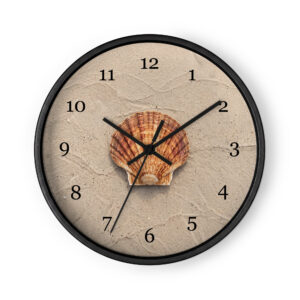
Norwegian Scallop Shell
$54.99 Select options This product has multiple variants. The options may be chosen on the product page