
Hallingdal Rosemaling
Bold flowers, balanced patterns, and rich color give Hallingdal rosemaling its distinctive presence. This regional Norwegian painting tradition brings a sense of structure and rhythm to decorated surfaces.
When did Hallingdal rosemaling develop?
The recognizable Hallingdal style took shape in the late 1700s and developed further during the 1800s. It grew through the work of several painters rather than appearing as a complete style in a single year.
Herbrand Embrikson Sata (1753–1830), from Ål, helped lay its foundations. His painted chests show a transition from elaborate Rococo decoration in the 1780s toward more symmetrical arrangements around the turn of the century. Dated examples from 1786, 1798, and 1799 help trace that development.
What makes the style recognizable?
Symmetry is an important feature in many Hallingdal designs: flowers and curved forms often balance one another around a central line. Stylized flowers, C-shaped curves, and repeated motifs can create a strong, organized composition. Individual painters developed their own approaches, so these features are useful guides rather than rules for every piece.
Color is equally important. In Sata’s work, blue, yellow, and white appear against red or green backgrounds. These combinations are historical examples, not a fixed palette that every Hallingdal design must follow.
Painters who carried the tradition forward
Sata’s sons, Nils and Embrik Bæra, continued developing the local style. Embrik H. Bæra (1788–1876) became one of Hallingdal’s leading decorative painters of the 1800s.
His decorations in the Villandstova from Hol are signed 1824. He worked on both household objects and entire interiors, and his commissions extended beyond Hallingdal into Sogn. His career shows how a regional tradition could develop a recognizable identity while still moving between places.
More than flowers
Historic Hallingdal painting was not limited to floral patterns. Embrik Bæra also painted religious scenes and figures. Looking at the tradition as a whole reveals a wider range of subjects than the flower arrangements often associated with rosemaling today.
A living tradition
Hallingdal rosemaling also has a place in Norwegian-American folk art. Vesterheim’s collection includes a sugar bucket painted by John H. Gundersen in Minneapolis in 1975, with Hallingdal-style decoration on an orange-red background. It was shown in Norway that year in the “Rosemaling in America” exhibition.
Contemporary classes continue to explore symmetry, brushwork, and fine detail. The tradition remains something people practice, interpret, and pass on.
Hallingdal-inspired design today
For modern designs, Hallingdal offers inspiration through the relationship between bold floral forms, repetition, and balance. The clocks shown below are contemporary interpretations inspired by this tradition.
Explore related clocks
-
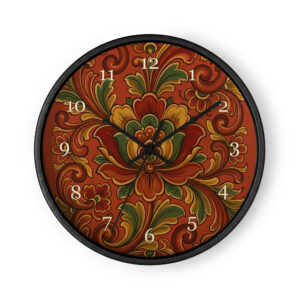
Hallingdal Rosemaling – Red and Gold Norwegian Folk Art
$54.99 Select options This product has multiple variants. The options may be chosen on the product page -
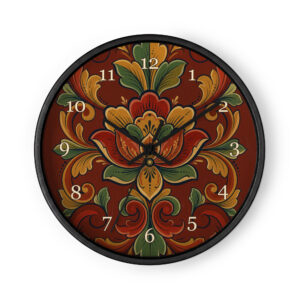
Hallingdal Rosemaling – Red Gold and Green Flowers
$54.99 Select options This product has multiple variants. The options may be chosen on the product page -
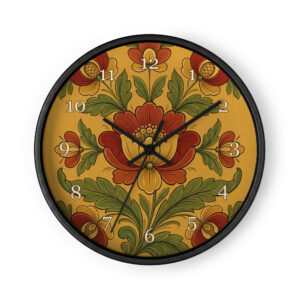
Norwegian Rosemaling – Hallingdal Folk Art, Yellow Ochre
$54.99 Select options This product has multiple variants. The options may be chosen on the product page