
Norwegian Rosemaling
Flowers, curling leaves, and expressive brushwork turn everyday objects into something distinctive. Rosemaling is a Norwegian decorative painting tradition with many regional styles, shaped by local painters and changing artistic influences.
When did rosemaling begin?
Rosemaling became an important part of rural Norwegian decoration during the 1700s and 1800s. Its background reaches further back: painted churches of the 1600s featured foliage, inscriptions, and biblical scenes that formed part of the decorative world later painters drew upon.
Baroque ornament and, later, Rococo curves influenced the developing tradition. From the 1760s, Rococo forms contributed to lighter, more freely arranged decoration in parts of Norwegian rosemaling. The changes did not happen everywhere at once, and there is no single year that marks the beginning of every regional style.
What does the name mean?
Rosemaling is commonly described in English as “rose painting,” but the decoration is not limited to roses. The origin of the Norwegian term is debated: it may relate to flowers or to dialect words associated with patterned or decorated surfaces. The name became widely used around 1890, long after many historic works had been painted.
Art in the home
Painted chests and ale bowls were important objects in the tradition. Decoration also extended to cupboards, beds, doors, walls, and ceilings. A room could become a complete painted environment rather than simply a setting for decorated furniture.
One dated example is the interior of Nestegardsstugu in Hovet, painted by Kitil Rygg in 1759. Flowers, scrolls, and figures cover much of its surface. The building is now at Hol Bygdemuseum.
Regional styles and individual painters
Telemark rosemaling is often associated with sweeping scrolls and asymmetrical movement. Hallingdal designs frequently emphasize symmetry and more structured floral arrangements. These are helpful distinctions, not strict rules for identifying every object.
Other regional traditions include Numedal, Setesdal, and Vest-Agder. Individual painters brought their own ideas to the work, and the name of a style does not always establish where an object was made.
A Norwegian-American connection
Norwegian immigrants also carried decorative painting traditions to the United States. Per Lysne, who emigrated from Lærdal to Stoughton, Wisconsin, in 1907, became an important figure in the Norwegian-American revival.
Vesterheim holds a decorated wooden plate by Lysne dated 1930–1945. Its flowers and leaves offer a tangible example of the tradition being practiced in a new setting, rather than remaining only a memory of Norway.
Rosemaling-inspired design today
Historic rosemaling was painted by hand, with variations in brushwork, composition, and color. Contemporary designs can draw inspiration from that visual language while using different materials and production methods.
The clocks below are modern rosemaling-inspired designs. Their flowers, curves, and decorative rhythms connect an everyday object with a longstanding Norwegian artistic tradition.
Explore related clocks
-
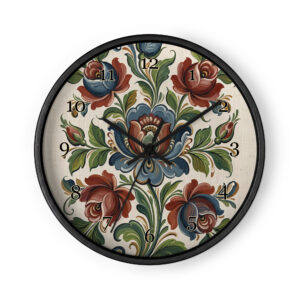
Classic Norwegian Rosemaling
$54.99 Select options This product has multiple variants. The options may be chosen on the product page -
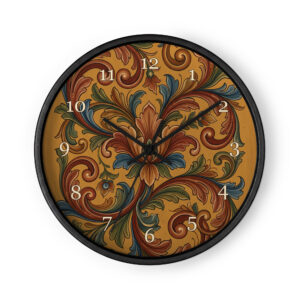
Gudbrandsdal Rosemaling – Ochre Floral Scrolls
$54.99 Select options This product has multiple variants. The options may be chosen on the product page -
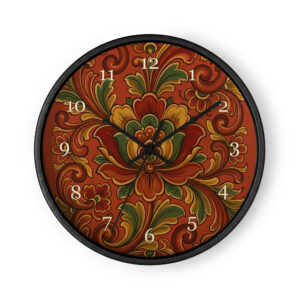
Hallingdal Rosemaling – Red and Gold Norwegian Folk Art
$54.99 Select options This product has multiple variants. The options may be chosen on the product page -
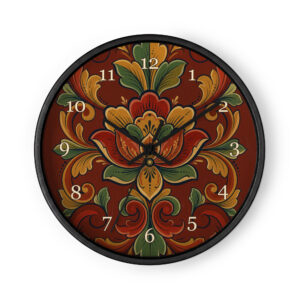
Hallingdal Rosemaling – Red Gold and Green Flowers
$54.99 Select options This product has multiple variants. The options may be chosen on the product page -
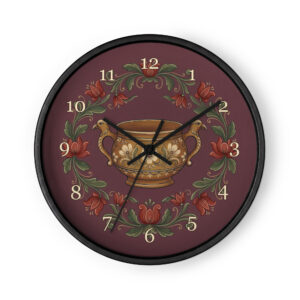
Norwegian Rosemaling – Bird Head Kjenge Folk Art
$54.99 Select options This product has multiple variants. The options may be chosen on the product page -
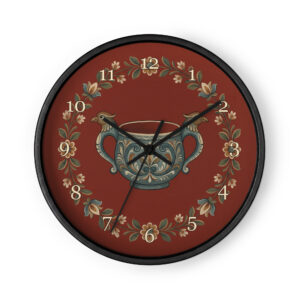
Norwegian Rosemaling – Bird Head Kjenge on Red
$54.99 Select options This product has multiple variants. The options may be chosen on the product page