Rosemaling in Numedal
Numedal’s decorative painting belongs to a valley connected with both rural craft and the nearby town of Kongsberg. Its history shows how the movement of goods and money could also carry artistic ideas into homes.
The Kongsberg connection
During the seventeenth and eighteenth centuries, supplying timber to the Kongsberg silver works brought income into Numedal. Lågdalsmuseet connects this activity with the construction of more substantial buildings and the arrival of decorative influences from the town.
The museum also notes that several painters from Numedal learned in Kongsberg. This connection helps explain why rural decoration should not be imagined as an isolated art. Craftspeople could encounter new approaches through training and travel, then adapt them for local customers.
Sebjørn Kverndalen
Sebjørn Kverndalen (1783–1875) is one of the named painters associated with Numedal. His work provides a more specific historical starting point than a generalized description of “old Norwegian flowers.” His style is still studied in contemporary rosemaling teaching, including a Vesterheim course devoted to him in 2024.
A painter’s long working life can also include change. Studying a dated object and its attribution is more useful than assuming one set of decorative features explains every work from a valley.
Looking at painted ornament
On a Numedal-inspired design, consider how the flowers and leaves occupy the available field. Trace the main stems before focusing on small accents. Notice where a light shape meets a darker ground, and how repetition connects separate parts of the pattern.
The clock below is a contemporary design associated with Numedal folk-art inspiration. It offers a way to enjoy floral ornament in daily life, while the historical painting tradition encompasses wooden furnishings, objects, and the interiors for which they were made.
Explore related clocks
-
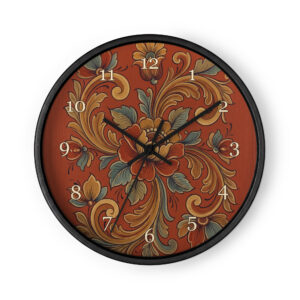
Norwegian Rosemaling – Numedal Folk Art, Red Ochre
$54.99 Select options This product has multiple variants. The options may be chosen on the product page