
Rosemaling in Oppdal
Oppdal’s decorative painting grew alongside its woodcarving. Looking at the two together helps explain why a painted cupboard, an elaborate doorway, and a decorated room can feel related even when they were made for different purposes.
Knut Horne and a room from 1795
Knut Eriksen Horne (1763–1848) was both a painter and a woodcarver. His decoration of Vikastuggu from Oppdal in 1795 is an important example of the way ornament could shape an entire interior. Red and blue forms worked against a pale ground, with scrolls and rosettes balanced by areas of undecorated wood.
The original decoration was lost in a fire in 1975 and later reconstructed as far as possible. That distinction matters when discussing what survives today: a reconstruction helps communicate a historical design, but it is not the untouched original surface.
More than one painter’s style
Tørres Evensen Uv (1779–1809) offers another side of Oppdal painting. His surviving work includes figures, riders, and mythological subjects alongside floral ornament. The Midthaug craftspeople also combined carving and painting, using Rococo-inspired forms in furniture and interiors.
These different approaches make Oppdal more interesting than a single formula. A regional label can gather related work while still leaving room for distinct hands and changing fashions.
Following a curve
On a painted design, try following a C-shaped curve from one end to the other. Notice whether it finishes in a leaf, a blossom, or an open space. Then consider how the pattern would change if that curve were carved into wood instead of painted on a flat ground.
The Oppdal-themed clock below is a contemporary interpretation of this decorative setting. Its circular format offers a different surface for exploring the relationship between flowers, curves, and balance.
Explore related clocks
-
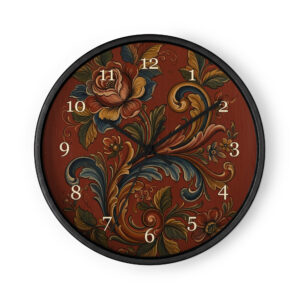
Norwegian Rosemaling – Oppdal Folk Art, Reddish Brown
$54.99 Select options This product has multiple variants. The options may be chosen on the product page