
Rosemaling in Østerdalen
Decorative painting in Østerdalen is a story of rooms as well as individual objects. Painted ornament could frame a doorway, run along a wall, or help distinguish one part of an interior from another. Looking at complete buildings reveals a wider picture than looking at flowers alone.
Different places, different timelines
Glomdalsmuseet describes an important contrast within the valley. In northern Østerdalen, the first half of the nineteenth century was a particularly strong period for decorative painting. Farther south, it was already becoming less fashionable in the early 1800s. A regional name therefore does not imply one uniform timeline.
Layers in Olenstua
Olenstua, from Alvdal and now at Glomdalsmuseet, was probably built in the mid-1770s and renovated in the 1820s. Its painted decoration belongs to different periods and techniques. Rococo ornament, scrolling forms around openings, and unusual plant-like motifs on door panels tell a layered story.
The museum suggests that some of the unusual painting may have been done by someone from another valley. That possibility is a reminder to leave room for travel and individual skill when describing local traditions.
A house on a travel route
At Oddentunet in Narjordet, an early nineteenth-century main house preserves decorative painting within a setting linked to travel and trade between Dalarna in Sweden and Røros. The house connects interior decoration with a working place where people stayed and passed through.
Looking at the pattern
For a contemporary Østerdal-inspired design, notice the relationship between ornament and background. Think about how a border frames a field, or how a repeating curve gives the eye a route through the composition. The clock below uses regional inspiration on a modern circular surface, rather than reproducing one of these historic interiors.
Explore related clocks
-
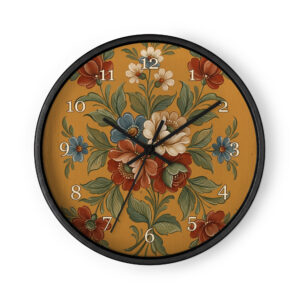
Norwegian Rosemaling – Østerdal Folk Art, Warm Ochre
$54.99 Select options This product has multiple variants. The options may be chosen on the product page