
Sea Urchins and Their Shells
An empty sea-urchin shell reveals a pattern that is partly hidden on the living animal. Rows of small bumps and openings run across a rounded surface, creating a natural arrangement that can look almost deliberately decorated.
The structure beneath the spines
The hard structure is called a test. It is a calcareous skeleton, rather than a mollusk’s shell. On a living urchin, spines and tube feet form part of the animal’s working surface. When those are gone, the underlying arrangement becomes much easier to see.
Sea urchins are echinoderms, related to starfish. Their organization reflects a five-part pattern. Many have a specialized five-toothed feeding structure on the underside, traditionally called Aristotle’s lantern.
Part of a changing coastal habitat
Urchins occupy many marine environments. Along Norway’s coast, their grazing can have a major effect on kelp. Where large numbers feed intensively, kelp forests can give way to areas with much less vegetation. This makes the animal important to the surrounding habitat, not simply interesting for its shape.
Looking at a sea-urchin design
The shell-themed clock focuses attention on that underlying surface. Follow a row from the center toward the edge, then notice the rhythm created by neighboring rows. Light and shadow can emphasize the curve without needing a complicated background. The image explores the broader form of an urchin test without requiring an exact species identification.
Explore related clocks
-
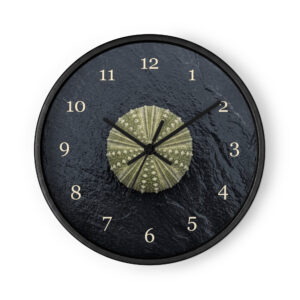
Norwegian Sea Urchin Shell
$54.99 Select options This product has multiple variants. The options may be chosen on the product page