
The Ship’s Engine Order Telegraph
The engine order telegraph is a reminder that running a ship depended on communication between people in different parts of the vessel. Its handle and marked positions allowed an order from the bridge to be understood in the engine room.
Sending an order
Moving the bridge handle indicated the desired engine setting, such as ahead or astern at a specified speed. The engine-room crew acknowledged the order by returning a matching indication. The exchange helped confirm that the instruction had been received.
In this traditional arrangement, the telegraph communicated what the crew should do; it was not simply a throttle directly operating the machinery. Signals could be transmitted mechanically or electrically, depending on the system.
A familiar feature of steamship life
The instrument was widely used during the steamship era. Later systems included direct electronic controls and other means of communication. A surviving telegraph therefore tells us about the organization of work as well as the machinery aboard a vessel.
Its face is especially readable as an image. Separate positions divide the dial, while a pointer turns a spoken instruction into a visible setting.
From shipboard instrument to clock motif
The related clock draws on the appearance of a vintage ship telegraph. The shared use of a circular face gives the subject a close visual relationship with timekeeping. Look at the relationship between the center, the surrounding divisions, and the outer frame: each helps a compact design suggest a larger working ship.
Explore related clocks
-
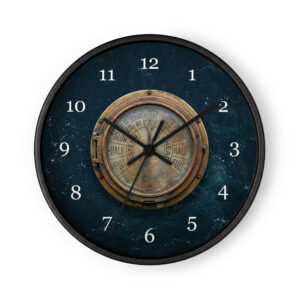
Vintage Ship Telegraph
$54.99 Select options This product has multiple variants. The options may be chosen on the product page