
Telemark Rosemaling
Flowing curves, imaginative flowers, and a sense of movement: Telemark rosemaling is one of Norway’s distinctive decorative painting traditions.
When did Telemark rosemaling begin?
Rosemaling flourished in rural Norway during the 1700s and 1800s. Telemark became one of its important regional centers. There is no single documented “birthday” for the Telemark style: it developed over time as painters adapted decorative ideas to local homes and objects.
Baroque ornament provided an important starting point. From the 1760s, Rococo influences helped introduce lighter, more playful arrangements, including curling C-shaped forms. These dates describe a gradual development, rather than the invention of a finished style in one particular year.
What makes the style recognizable?
Telemark painting is often associated with asymmetrical compositions: the two sides do not have to mirror one another for the design to feel balanced. Flowers, leaves, and sweeping scrolls can guide the eye around a bowl or across a painted surface.
Sweeping scrolls are a hallmark of the style, alongside variations that put flowers at the center. One Telemark design studied at Vesterheim, for example, emphasizes flowers rather than the usual scrolls while retaining an asymmetrical flow. This is a variation within the tradition, not a replacement for its characteristic scrollwork.
Historic painters and dated examples
Olav Hansson, whose life dates are approximately 1750–1820, is associated with major painted interiors in eastern Telemark. The interior at Kleppen in Sauland bears a signature dated 1804. His bold brushwork and use of color show how individual painters helped shape the tradition.
Another important painter was Nikuls Buine (1789–1852) from Fyresdal. Vesterheim holds a bentwood box painted by him and dated to about 1850. Objects like this make the history tangible: a regional painting tradition was part of everyday things that people used and kept.
A style that traveled
A Telemark-style design does not necessarily mean an object was made in Telemark. Vesterheim records an 1860 trunk with Telemark-style decoration that may have come from Sogn, and notes comparable trunks in both Sogn and Hardanger.
Buine emigrated with his family in 1852. Today, museum collections and painting classes help new generations explore the tradition, including at Vesterheim in Iowa.
Telemark-inspired design today
For a contemporary design, the inspiration lies in that interplay of flowers, curves, and movement. The clocks below are modern designs inspired by Telemark rosemaling, bringing an echo of the tradition into an everyday object.
Explore related clocks
-
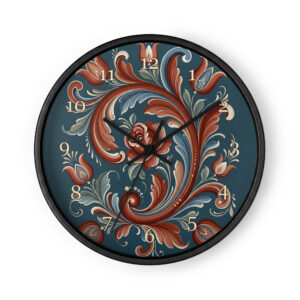
Telemark Rosemaling – Blue and Red Norwegian Folk Art
$54.99 Select options This product has multiple variants. The options may be chosen on the product page -
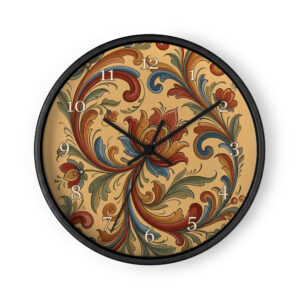
Telemark Rosemaling – Gold Red and Blue Scrolls
$54.99 Select options This product has multiple variants. The options may be chosen on the product page -
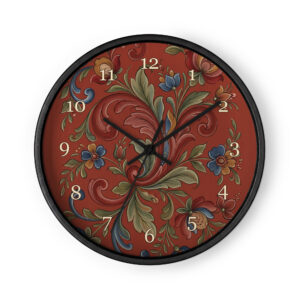
Telemark Rosemaling – Red Floral Norwegian Folk Art
$54.99 Select options This product has multiple variants. The options may be chosen on the product page